The Rise of Multimodal AI
The Rise of Multimodal AI
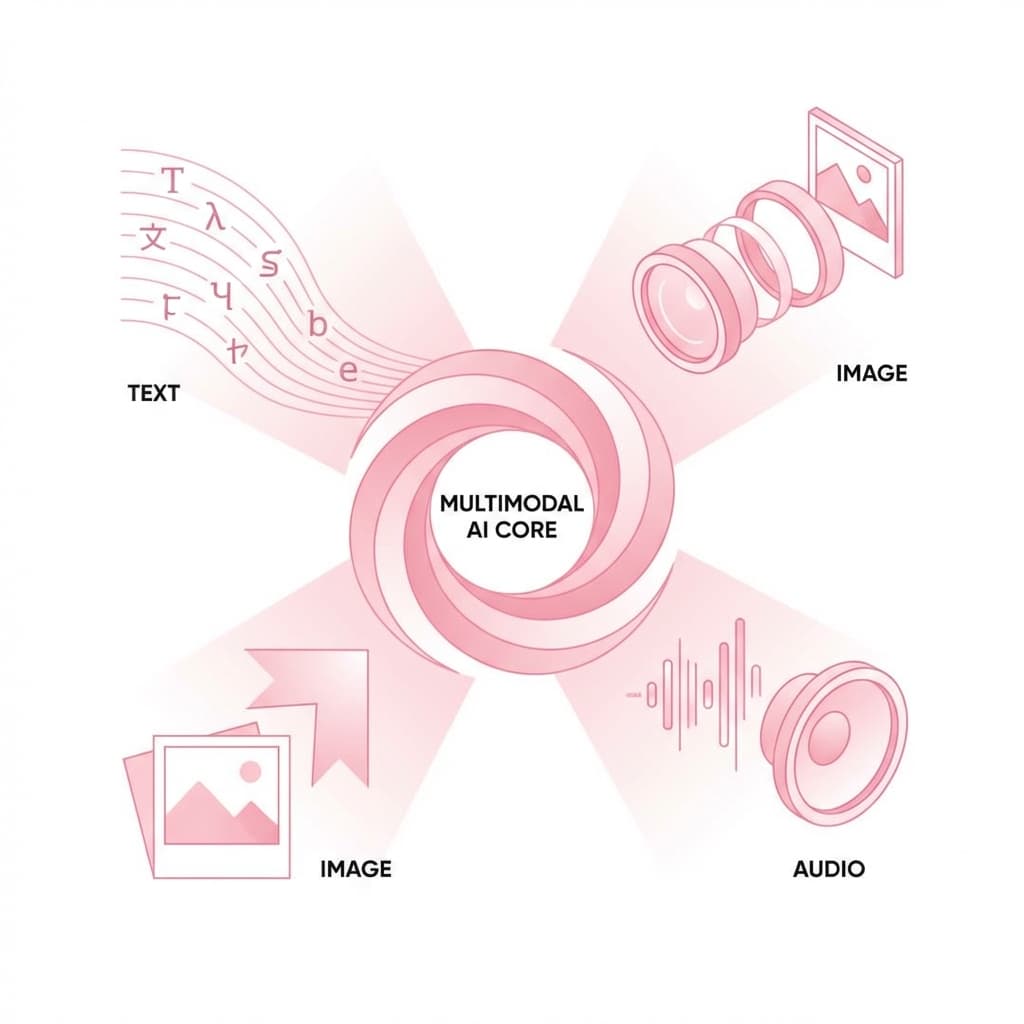
Multimodal AI systems can process and generate multiple types of data—text, images, audio, and video. They represent a significant step toward more general artificial intelligence.
What Is Multimodal AI?
Traditional AI systems are specialists:
- LLMs process text
- CNNs process images
- Speech models process audio
Multimodal AI integrates these capabilities:
- See and describe images
- Understand diagrams
- Listen and respond
- Generate across modalities
Key Breakthroughs
Vision-Language Models
GPT-4V, Claude 3, and Gemini can:
- Analyze images and charts
- Read text in images
- Understand visual context
- Answer questions about visuals
Image Generation
DALL-E, Midjourney, and Stable Diffusion:
- Generate images from text
- Edit existing images
- Create variations
- Understand style
Audio Understanding
Whisper, Gemini, and others:
- Transcribe speech
- Understand music
- Process environmental sounds
- Enable voice interfaces
Video Models
Sora, Runway, and emerging models:
- Generate video from text
- Understanding motion
- Temporal consistency
- Scene comprehension
Applications
Document Understanding
Process documents with mixed content:
- Invoices with logos
- Scientific papers with figures
- Presentations with charts
Accessibility
Bridge between modalities:
- Describe images for visually impaired
- Caption videos automatically
- Voice control for interfaces
Creative Tools
New possibilities for creators:
- Text-to-image generation
- Style transfer
- Video editing assistance
- Music generation
Robotics
Understanding the physical world:
- Visual navigation
- Object manipulation
- Task understanding
Technical Approaches
Early Fusion
Combine modalities at the input level:
- Joint embedding space
- Unified architecture
Late Fusion
Process separately, combine later:
- Modality-specific encoders
- Combined reasoning layer
Cross-Attention
Allow modalities to attend to each other:
- Rich interactions
- Flexible architecture
Challenges
- Alignment: Ensuring modalities are properly synchronized
- Scale: Training requires massive diverse datasets
- Evaluation: Measuring capabilities across modalities
- Efficiency: Processing multiple modalities is expensive
Conclusion
Multimodal AI is making systems that perceive the world more like humans do. As these capabilities mature, expect AI to become more natural and capable partners in increasingly complex tasks.