RAG: Retrieval Augmented Generation
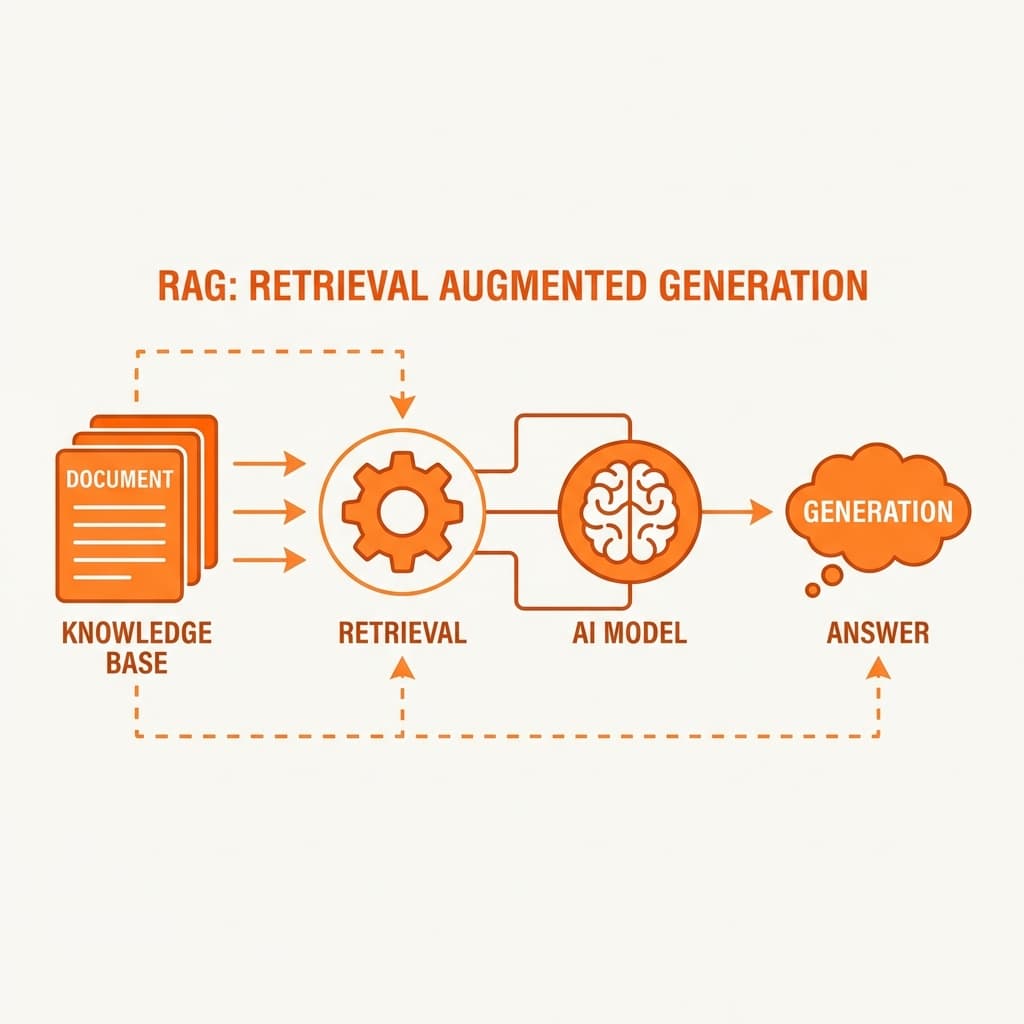
RAG: Retrieval Augmented Generation
Retrieval Augmented Generation (RAG) is an architecture pattern that enhances large language models by grounding their responses in retrieved knowledge. It's become the go-to approach for building knowledge-aware AI applications.
The Problem with Pure LLMs
Large language models have impressive capabilities, but they also have limitations:
- Knowledge cutoff: Training data has an end date
- Hallucinations: Confident but incorrect responses
- No access to private data: Can't reference your documents
How RAG Works
RAG combines two components:
1. Retriever
Searches a knowledge base for relevant information based on the user's query.
2. Generator
Uses the retrieved information as context to generate accurate, grounded responses.
RAG Architecture
User Query
    │
    ▼
┌─────────────┐
│  Embedding  │
│    Model    │
└─────────────┘
    │
    ▼
┌─────────────┐     ┌─────────────┐
│   Vector    │────▶│  Retrieved  │
│   Search    │     │  Documents  │
└─────────────┘     └─────────────┘
                          │
                          ▼
                    ┌─────────────┐
                    │   Prompt    │
                    │  + Context  │
                    └─────────────┘
                          │
                          ▼
                    ┌─────────────┐
                    │     LLM     │
                    │  Generation │
                    └─────────────┘
                          │
                          ▼
                      Response
Key Components
Document Processing
- Chunking documents into manageable pieces
- Creating embeddings for each chunk
- Storing in a vector database
Query Processing
- Embedding the user's question
- Finding relevant chunks
- Ranking results
Context Integration
- Formatting retrieved documents
- Constructing effective prompts
- Managing context window limits
Best Practices
- Chunk wisely: Balance between context and specificity
- Use metadata: Filter by source, date, or type
- Implement reranking: Improve retrieval quality
- Add citations: Show sources for transparency
- Handle failures: Graceful degradation when no relevant docs found
Advanced Techniques
Hybrid Search
Combine vector similarity with keyword matching for better recall.
Query Expansion
Rephrase queries to improve retrieval coverage.
Iterative Retrieval
Multiple rounds of retrieval for complex questions.
Conclusion
RAG bridges the gap between static LLM knowledge and dynamic, domain-specific information. It's essential for building AI applications that need to be accurate, current, and verifiable.