LLMs and Fine-Tuning
LLMs and Fine-Tuning
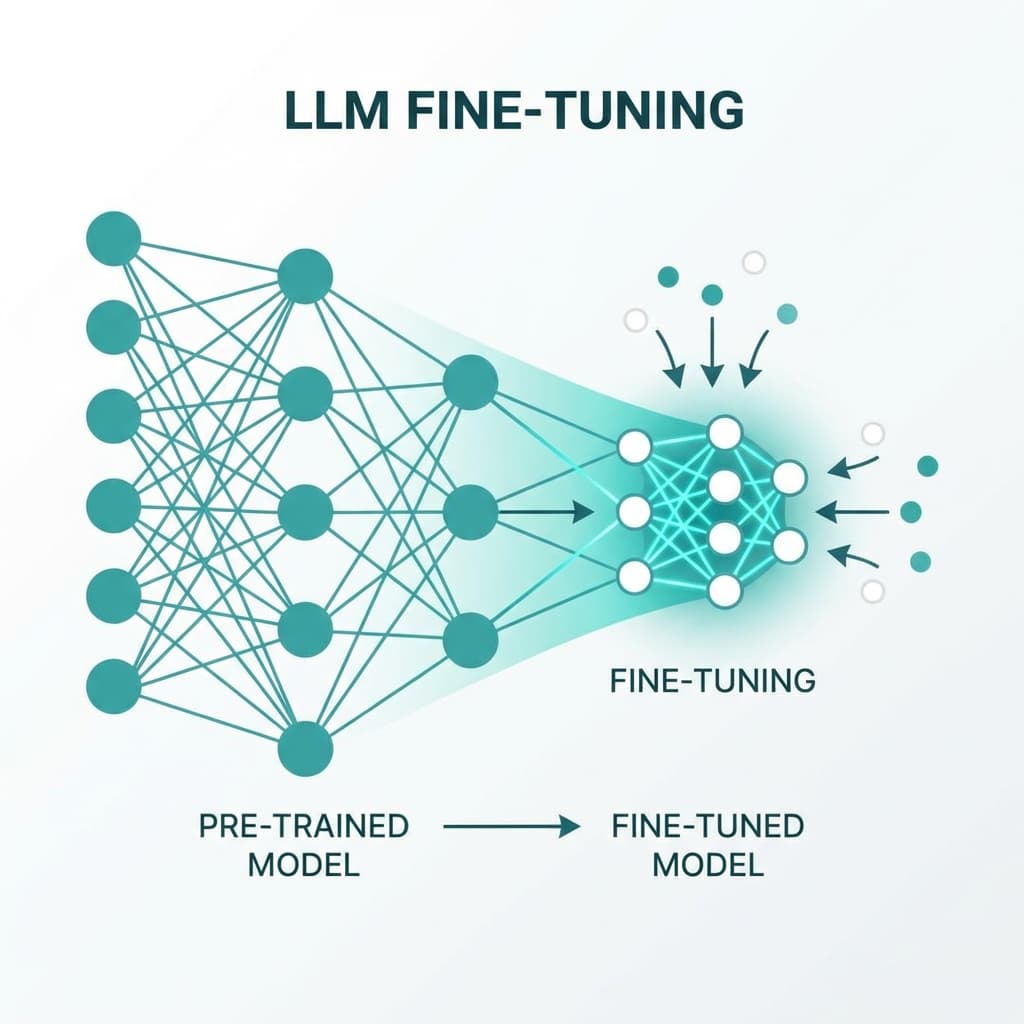
Large Language Models (LLMs) have transformed what's possible with AI. But out-of-the-box models don't always fit specific use cases. Fine-tuning allows you to customize these models for your needs.
What Are LLMs?
LLMs are neural networks trained on vast amounts of text data. They learn patterns in language that enable them to:
- Generate coherent text
- Answer questions
- Translate languages
- Write code
- And much more
The Fine-Tuning Spectrum
In-Context Learning (No Training)
Simply provide examples in your prompt. Works for many use cases with no additional cost.
Prompt Tuning (Minimal Training)
Learn a small set of "soft prompts" that guide the model. Very parameter-efficient.
LoRA (Low-Rank Adaptation)
Train small adapter layers that modify model behavior. Good balance of efficiency and capability.
Full Fine-Tuning
Update all model parameters. Most powerful but requires significant resources.
When to Fine-Tune
Fine-tuning makes sense when you need:
- Consistent style or format
- Domain-specific knowledge
- Specialized behaviors
- Reduced prompt length
- Better performance on specific tasks
When NOT to Fine-Tune
- Few examples: Prompting may be enough
- Rapidly changing data: Use RAG instead
- Limited compute: Start with smaller models
- Unclear requirements: Experiment first
The Fine-Tuning Process
1. Prepare Your Data
Create a dataset of input-output pairs that demonstrate desired behavior.
{
  "messages": [
    {"role": "user", "content": "Summarize this article..."},
    {"role": "assistant", "content": "The article discusses..."}
  ]
}
2. Choose Your Approach
Select based on your resources and requirements:
- LoRA for efficiency
- Full fine-tuning for maximum customization
3. Train the Model
Use frameworks like:
- Hugging Face Transformers
- OpenAI's fine-tuning API
- Axolotl
- LLaMA Factory
4. Evaluate
Test on held-out examples and real-world scenarios.
5. Deploy
Serve your fine-tuned model via API or locally.
Best Practices
- Quality over quantity: 100 great examples beat 10,000 poor ones
- Diverse examples: Cover the range of expected inputs
- Validate formatting: Consistent structure matters
- Monitor for drift: Test regularly in production
Conclusion
Fine-tuning is a powerful tool for customizing LLMs, but it's not always necessary. Start with prompting, try RAG for knowledge, and fine-tune when you need specific behaviors that can't be achieved otherwise.