Edge AI and On-Device Intelligence
Edge AI and On-Device Intelligence
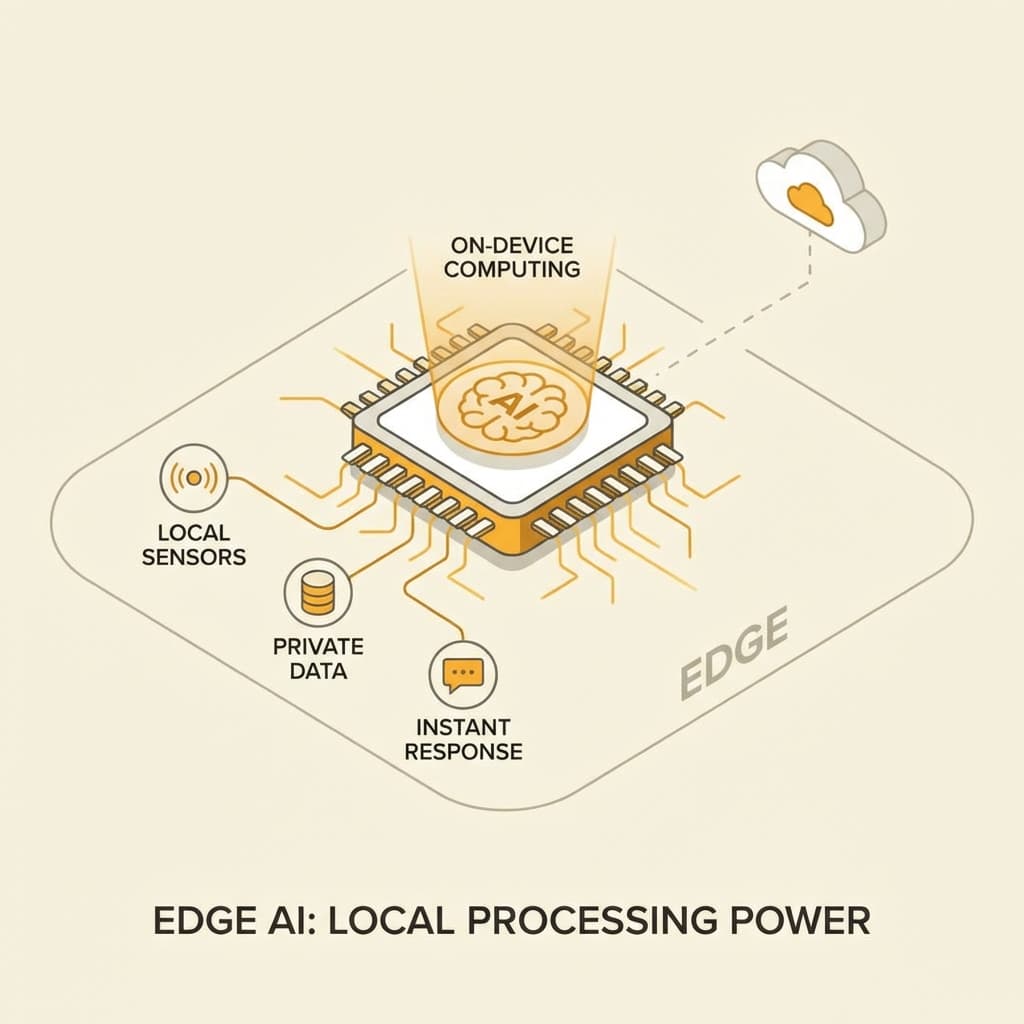
Edge AI brings machine learning computation to local devices rather than relying on cloud servers. This shift is transforming how we deploy AI applications.
Why Edge AI?
Latency
Cloud round-trips add delay. Edge AI provides:
- Instant responses
- Real-time processing
- No network dependency
Privacy
Data stays on device:
- No cloud transmission
- User data remains local
- Reduced attack surface
Cost
No ongoing cloud bills:
- One-time hardware cost
- No API fees
- Predictable expenses
Reliability
Works offline:
- No internet required
- No service outages
- Always available
Enabling Technologies
Model Optimization
Quantization: Reduce precision (FP32 → INT8) for smaller, faster models.
Pruning: Remove unnecessary weights and connections.
Distillation: Train smaller models to mimic larger ones.
Hardware Acceleration
Neural Processing Units (NPUs) Dedicated AI chips in phones and laptops.
GPUs Graphics processors optimized for parallel computation.
TPUs Google's tensor processing units for ML workloads.
CPUs with AI Extensions Modern CPUs include AI-specific instructions.
Edge AI Platforms
| Platform | Type | Use Case | |----------|------|----------| | Apple Core ML | Mobile | iOS/macOS apps | | TensorFlow Lite | Mobile | Cross-platform mobile | | ONNX Runtime | Cross-platform | Universal deployment | | OpenVINO | Edge devices | Intel hardware | | Qualcomm AI Engine | Mobile | Android devices |
Applications
Smartphones
- Face recognition
- Voice assistants
- Photo enhancement
- Text prediction
Smart Home
- Voice control
- Person detection
- Energy optimization
- Anomaly detection
Automotive
- Driver monitoring
- Object detection
- Lane keeping
- Voice commands
Industrial
- Quality inspection
- Predictive maintenance
- Safety monitoring
- Process optimization
Healthcare
- Wearable analytics
- Medical imaging
- Vital monitoring
- Drug dosing
Challenges
Limited Resources
Edge devices have constrained:
- Memory (RAM)
- Storage
- Compute power
- Battery life
Model Updates
Keeping models current:
- OTA updates
- Version management
- Rollback capabilities
Development Complexity
Different targets require:
- Platform-specific optimization
- Hardware-aware training
- Extensive testing
The Hybrid Future
Most practical systems combine edge and cloud:
- Edge for latency-sensitive tasks
- Cloud for complex processing
- Sync when connected
- Graceful degradation offline
Conclusion
Edge AI is making intelligent applications faster, more private, and more reliable. As hardware improves and models shrink, expect more AI capabilities to move from the cloud to your pocket.